Sergeyich–Pashka relationship
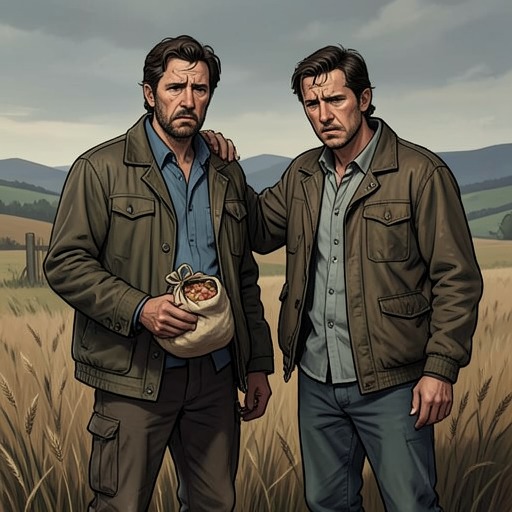
Grey BeesThe Sergeyich–Pashka relationship is a friendship formed in the narrowing world of wartime Little Starhorodivka: part practical partnership, part bickering, and increasingly a source of companionship neither man can easily replace. Sergeyich once thought of Pashka as a childhood enemy, but their exchanges of help, provisions, and attention gradually make them feel like brothers. When Sergeyich leaves with his bees, their restrained farewell reveals what their ordinary quarrels had come to conceal: Pashka is not simply a neighbor he can leave behind, but the person whose absence makes home feel empty.
From rivalry to everyday reliance
Sergeyich and Pashka’s closeness is built through repeated encounters rather than a declaration of friendship. Even when they squabble, Sergeyich feels closer to his former childhood enemy; he thinks of them as brothers, though not related by blood. Their bond remains teasing and imperfect. Pashka’s gratitude for repaired windows and a night spent at Sergeyich’s house has limits: he lets Sergeyich keep the binoculars for a while but does not share the lard he had mentioned. The omission matters because, in a wartime winter with no electricity and church candles for light, even the thought of a familiar food can sharpen the sense of what is missing. Sergeyich’s own supplies are sparse, and the story locates their growing intimacy in this everyday economy of need, irritation, and accommodation.
Pashka’s usefulness to Sergeyich is not merely practical. When mail returns to the village, the two men set out together to meet the Ukrainian-flag-colored van. Pashka wonders aloud what should happen to packages addressed to people who have died; Sergeyich answers with the matter-of-fact postal rule that they should be sent back. After the van leaves, Pashka carries the mailbag and suggests that they sort it at his house. There, they divide the letters by street so each can make deliveries, while Pashka studies the envelopes as if trying to remember their addressees. The work gives them a shared task amid a community emptied and disrupted by war.
Their exchanges also move between joking familiarity and tangible aid. When Sergeyich offers Petro honey, the gesture reflects the beekeeper’s habit of sharing what he has; elsewhere, Pashka gives Sergeyich money for five half-litre bottles of alcohol brought by the mail van’s companions. These transactions are not all alike: some are purchases, some are offers, and some help is not immediately repaid. Together they show how the neighbors navigate scarcity through a mixture of trade, hospitality, and personal trust.
The prospect of separation
When Sergeyich tells Pashka that he will leave with his bees, probably until August, Pashka’s first response is to ask whether he will be left alone. Sergeyich points out that Pashka has friends in Karuselino, but Pashka replies that one friend was killed in their village and describes his other contacts as unreliable, alternately treating him as a brother or rejecting him. He proposes a drink in memory of Vovka, also known as Vladlen. Sergeyich sets out honey vodka and glasses, and the two men drink to the dead man.
After the toast, Sergeyich offers to leave Pashka a key and asks him to look after the house. Pashka looks around and remarks that there is little worth stealing, particularly if Sergeyich takes his Lada. The comment hurts Sergeyich, but the exchange also makes plain how modest the entrusted responsibility is: there may be little to protect, yet Sergeyich still wants Pashka to have access to his home while he is gone.
Their leave-taking takes longer than its practical purpose requires. Sergeyich stops at Pashka’s house to hand over the key. Pashka insists that he have tea and urges him to drink to the journey; when Sergeyich declines the stronger drink, Pashka persuades him at least to drive him to the end of his street. Pashka puts on his red jacket, marked with a white cross, and then accompanies Sergeyich farther down the road than they had agreed. He cannot bring himself to say goodbye at the first stopping place.
A farewell measured in small gifts
At the roadside, Sergeyich extends his hand. Pashka has tears in his eyes; his raised hand meets Sergeyich’s, and the greeting becomes a brief, tightly held embrace. Their restraint—clasping each other and then quickly loosening their hold—fits a friendship that has grown through practical acts and habitual banter, not elaborate declarations.
Before driving away, Sergeyich tells Pashka that he has left a three-litre jar of honey on the kitchen windowsill, specifically for him. Then he sets off in his green Lada, towing a trailer carrying six hives under a tarpaulin. Pashka’s red jacket and its white cross recede in the rear-view mirror as he walks back toward the village. The honey is both food and a gift; after the key, it is another small provision left behind for the neighbor who will remain alone.
Distance, continued dependence, and return
From his campsite, Sergeyich calls Pashka, expecting that he may not be able to reach the village from outside the zone. Pashka answers, and their conversation quickly exposes the difference between their circumstances. Pashka has run out of supplies; a new, strict commander in Karuselino has stopped the men from visiting, and Pashka is afraid to go there himself. Sergeyich says the bees are comfortable and the honey easy to sell, and admits he expects to stay for a while. He feels guilty as he says it. Pashka asks him not to stay away too long, making the cost of Sergeyich’s departure unmistakable.
The call leaves Sergeyich sad. He had hoped for more news or more happiness from Pashka at hearing from him, but instead imagines his friend alone, with shells overhead and no one to talk to. Their connection persists across distance, but the call cannot substitute for company. In the same period, Sergeyich’s new life becomes more stable: Galya helps sell his honey, and cash accumulates in the glove compartment of his Lada. That stability makes staying away easier materially, even as Pashka’s isolation gives Sergeyich reason to feel the strain of it.
On the road back, Pashka calls to ask whether Sergeyich is already returning. He asks him to buy about thirty packs of Primas cigarettes and warns him to hide them because they may be taken at checkpoints. Sergeyich says he will conceal them among the bees, where inspectors will not reach. Pashka’s voice sounds almost happy as he tells Sergeyich to keep driving and says he will be waiting. Sergeyich responds inwardly that at least someone is waiting for him, and presses the accelerator. The cigarettes turn their friendship into a concrete errand once more, but the emotional consequence is larger: after a summer in which the village has meant solitude, Pashka’s expectation makes the journey home feel like a return to someone, not merely to a place.